Indonesia targets net zero emissions by 2060, with significant focus on renewable energy transition and emission reduction in the transportation sector. However, there's one emission contributor that often escapes attention: paper consumption.
Data from the Indonesian Pulp and Paper Association (APKI) shows that Indonesia's per capita paper consumption reaches 32 kilograms per year, with national production capacity of 20.86 million tons in 2024.
Paper production generates substantial carbon emissions. Research from North Carolina State University indicates that one ton of paper produces an average of 942 kilograms of CO2 emissions throughout its production cycle, from tree felling to energy-intensive manufacturing processes.
Practical solutions like JPG to PDF conversion enable organizations to digitize documents without printing, providing real contributions to emission reduction. Amid the urgency of climate action, paperless office is no longer merely an operational efficiency trend but a concrete step in climate change mitigation strategy.
The Digital Paradox: Infrastructure Exists, Adoption Remains Low
Despite increasingly accessible digital infrastructure, paperless office adoption in Indonesia remains suboptimal. Indonesia's per capita paper consumption of 32 kilograms per year still indicates significant dependence on printed documents for administrative purposes, meeting materials, and documentation.
The culture of "documents must be printed for legitimacy" remains deeply rooted, especially in government institutions and traditional organizations.
This paper dependency creates layered impacts. Environmentally, paper production requires substantial natural resources and generates measurable emissions.
With national production capacity reaching 20.86 million tons per year and export contributions of USD 8.28 billion in 2023, Indonesia's pulp and paper industry is indeed vital to the national economy. However, the important question is: is all this paper consumption truly necessary, especially for documents used once and then discarded?
Paperless Office: Measurable Climate Action
Paperless office is the practice of minimizing paper use by shifting document processes to digital format. This doesn't mean completely paper-free, but rather using paper only for truly essential needs.
This transition brings various benefits: carbon emission reduction, operational cost savings, workflow efficiency, and improved document accessibility.
From a climate action perspective, the impact is measurable. With average emissions of approximately 1 kilogram of CO2 per kilogram of paper produced, every reduction in paper consumption directly contributes to emission decrease.
If 1,000 offices in Indonesia with an average of 100 employees each reduce paper consumption by 50%, potential emission reduction could reach thousands of tons of CO2 per year, equivalent to planting tens of thousands of trees.
Digital Tools as Transition Enablers
The transition to paperless office requires a supportive digital ecosystem. One of the biggest obstacles is managing documents that already exist in scanned or photographed form.
Many organizations have important archives in JPG format from scanning or document photography but struggle to integrate them into more structured digital systems.
Converting JPG to PDF format isn't just about technicalities, but about creating universal, secure, and easily manageable digital document standardization.
PDF format allows documents to appear consistently across various devices, can be password-protected, and is lighter for sharing via email or cloud storage compared to multiple separate image files.
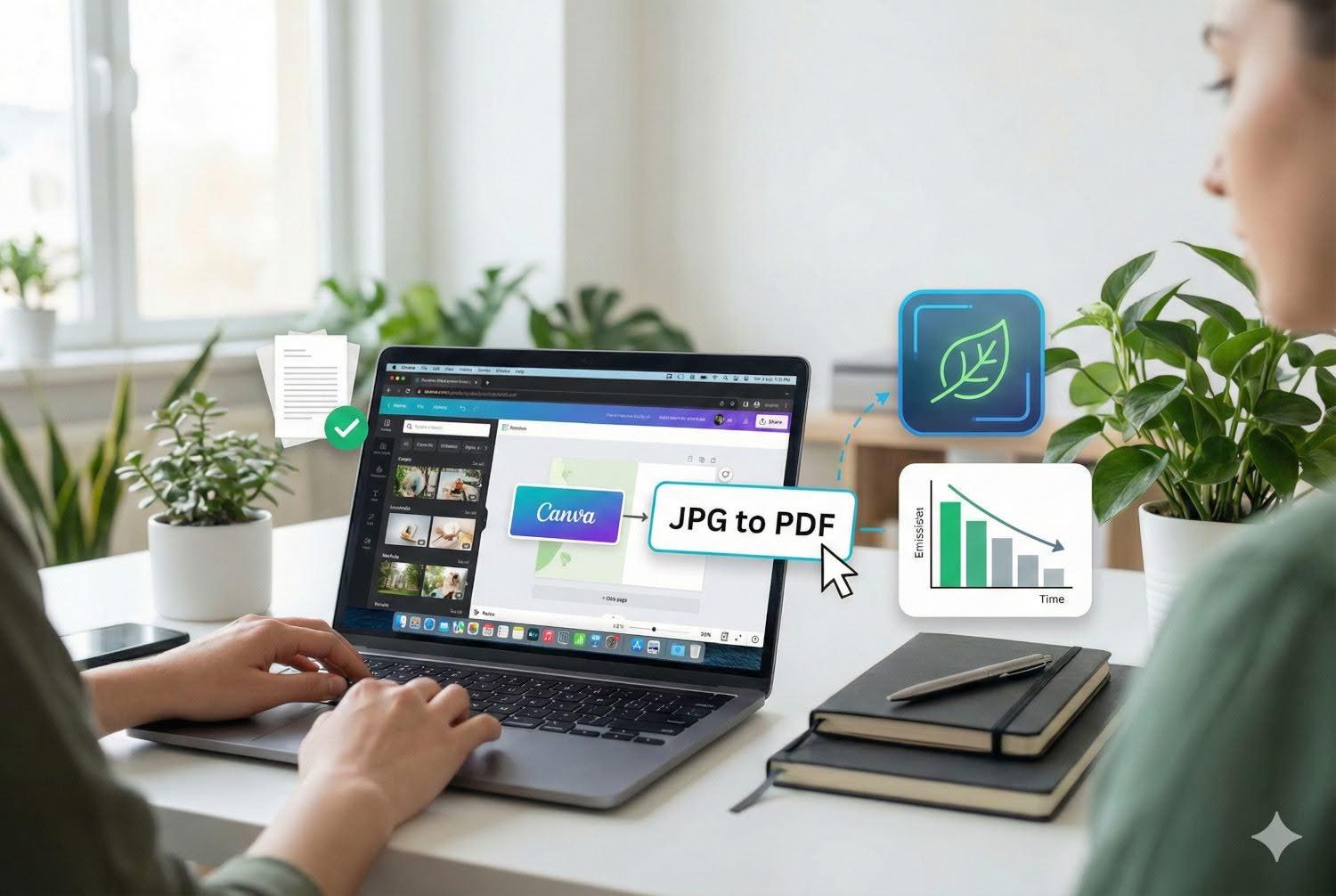
Design platforms like Canva now provide JPG to PDF conversion features that simplify the conversion process without requiring specialized software.
This feature is highly useful for various needs: compiling scanned invoices into one PDF file for accounting, converting project documentation photos into neat digital reports, or archiving old documents in a more sustainable format.
How to Convert JPG to PDF in Canva
The document digitization process is now easier with user-friendly online tools:
Access the JPG to PDF conversion feature through your browser. No additional app installation or special technical expertise required.
Upload the JPG file you want to convert. You can upload one file or multiple files at once to combine various images into one PDF document.
If uploading multiple images, arrange the page order as needed. You can also make simple edits like cropping or resizing if necessary.
Click the convert button. The process usually takes only a few seconds. Once complete, download the PDF file ready for professional use.
Tools like these lower technical barriers to paperless adoption, especially for SMEs and organizations with limited IT resources. The converted files maintain quality, have optimal size for sharing, and are compatible with all digital platforms.
SPBE Policy: An Underutilized Foundation
The Indonesian government actually already has a digital policy foundation through Presidential Regulation No. 95 of 2018 on Electronic-Based Government System (SPBE). The UN E-Government Survey 2024 ranks Indonesia 64th out of 193 countries, with a national SPBE index of 3.12 ("Good" category), showing progress in government digital transformation.
However, field implementation remains inconsistent. Many agencies use digital systems but still require printouts as "official archives"—a contradiction reflecting the gap between policy and organizational culture.
More problematically, there are no clear incentives to encourage paperless adoption in the private sector. Green procurement policies haven't strongly enforced paper reduction, and there's no carbon footprint reporting requirement for office operations.
In the context of Indonesia's Nationally Determined Contribution (NDC), the Enhanced NDC submitted in September 2022 sets emission reduction targets of 31.89% (unconditional) to 43.20% (conditional) by 2030.
Although office operational sectors rarely enter priority emission calculations, the cumulative impact of paperless offices across millions of formal sector employees could make significant contributions toward achieving these targets.
Concrete Steps Toward Paperless
Organizations can start with paper consumption audits, establish baselines, and create phased roadmaps.
Begin with easy steps like paperless meetings and digital approval workflows before moving to more complex documentation. Training and structured change management are essential to ensure entire teams engage in this transition.
The government needs to strengthen SPBE implementation with more consistent enforcement, provide fiscal incentives for organizations implementing green offices, and mandate carbon footprint reporting that includes office operations.
Investment in digital infrastructure, especially in regional areas, is also crucial to ensure inclusive transition that doesn't deepen digital divides.
At the individual level, we can start with a simple question before printing: "Does this really need to be printed?" Choose digital sharing as the primary option, support paperless-friendly companies, and advocate for paperless policies in our respective workplaces.
Time to Act
Paperless office isn't an instant solution to the climate crisis, but it's a practical step that can be taken immediately with already available technology.
In the context of Indonesia racing toward its 2060 net zero emission target, every sector plays an important role, including those often considered "small" like paper consumption in offices.
Digital tools are easily accessible, benefits are measurable, and basic regulations already exist. What's needed is collective commitment to implementation: from consistent government policies, organizational investment in digital transformation, to individual awareness in daily practices.
Take the first step today: digitize important documents, reduce paper dependency, and become part of Indonesia's climate action solution. There's no reason to delay—it's time to move from discourse to real action for sustainable green transition.